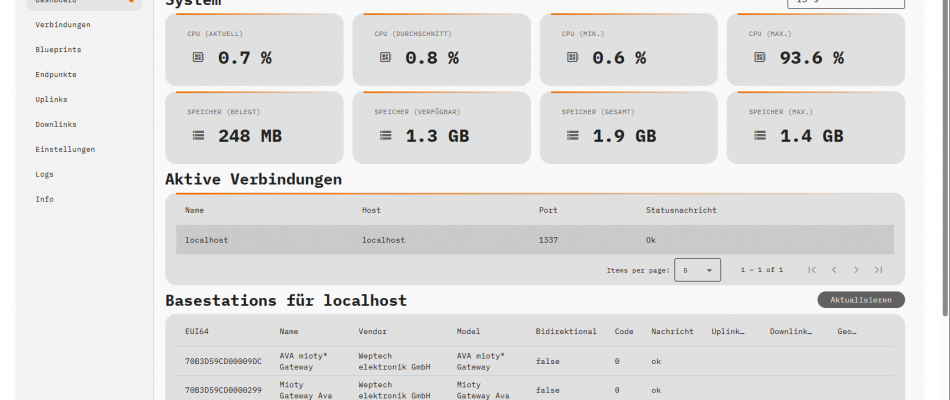
 At a Glance
Software Architecture
Deploying a robust Mioty wireless network requires efficient backend management. In standard ETSI-compliant architectures, the core infrastructure is split into distinct roles: Base Stations, a Service Center (SC) for network administration, and an Application Center (AC) for data processing. With LUPUS mySAC, we bring these core functionalities together under one umbrella, administered through a clean, intuitive WebUI frontend.
Whether you are operating municipal submetering networks or managing industrial IoT infrastructure, mySAC eliminates technical complexity, providing full visibility and control over your entire Mioty fleet from a central Web dashboard.
Dashboard & Monitoring
The core of mySAC is its intuitive management console. Designed for operational efficiency, the dashboard delivers instant insights into network health, connected hardware, and system load in real time.

Key Dashboard Modules & Capabilities:
 Real-Time Fleet DiagnosticsThe mySAC frontend provides immediate status updates for all registered gateways. Network administrators can instantly spot disconnected base stations or unusual uplink loads without sifting through server logs.
Network Administration
From the structured sidebar navigation, administrators can quickly access specialized modules designed for complete end-to-end management:
To learn more about how Mioty stacks up against other wireless technologies in submetering and smart buildings, read our detailed comparison: Submetering & Smart Building: Which Wireless Protocol Will Prevail?
Integration
LUPUS mySAC is designed to bridge field sensors with high-level software environments. By consolidating data streams from multiple base stations, mySAC can automatically decode and route payload data to external platforms, cloud servers, or local management platforms.
Whether you choose to forward decoded Mioty data directly into LUPUS Cloud, integrate with enterprise ERPs via MQTT/REST APIs, or deploy on-premise for high-security applications, mySAC serves as the flexible nerve center for your entire wireless infrastructure.
 LUPUS Expert Tip: Combine mySAC with Hybrid LPWAN GatewaysFor maximum reliability in complex industrial or municipal environments, combine LUPUS mySAC with multi-protocol gateways like the AVA2[cite: 1]. This ensures seamless handling of Telegram Splitting Mioty packets along with integrated backhaul options to cloud or local MQTT brokers. For an in-depth analysis on selecting wireless protocols for tough environments, explore our guide on Industrial IoT: Why Choosing the Right Wireless Technology is Critical.
Summary
LUPUS mySAC streamlines Mioty network administration by integrating Service and Application Center functions into a single, user-friendly WebUI. By offering clear live telemetry, straightforward device registration, and flexible data routing, mySAC empowers enterprise users, system integrators, and municipalities to roll out large-scale Mioty solutions with ease.
Explore our complete ecosystem of gateways, sensors, and management software on our LUPUS Mioty Solutions Overview.

About the Author
Philip Wolff
Managing Director, LUPUS-Electronics GmbH
Philip Wolff is co-founder and Managing Director of LUPUS-Electronics GmbH in Landau in der Pfalz, Germany. Founded in 2006, the family-owned company develops alarm systems, video surveillance, and smart home security technology designed for reliable, cloud-independent local execution.